Sunday, March 24, 2013

Don't touch that dial


Some of you may remember when long long ago in a vastly different era, we only got three or four TV stations (we also had to call the operator to make a long distance phone call, but that's another story).   Anyway, they were received via an antenna on the roof pointed toward the closest big city.  The pictures were black and white and really bad compared to today's standards.
 
Then came color and a few more stations.  And, then came cable.  Cable was first helpful in remote areas and usually did nothing more than redistributed TV signals from far away cities to homes that otherwise would have received nothing.

But, in 1975, HBO brought the next evolution, as the first non over-the-air programming service that was available only if you subscribed to cable.  Of course since then, hundreds of such providers make their programs available if you subscribe to cable or satellite.  They changed the game of television, dramatically reducing the number of viewers who would watch the traditional networks (ABC, CBS, NBC, and now Fox and the CW).

Now, a new player is emerging that likely will likely reduce the influence  of cable and satellite.  It has been stumbling along for a few years, but now, for the first time, it has become a viable viewing alternative.  It is online distribution of original programming.

Up until now, the quality of entertainment programs viewable only on the web has been, for the most part, elementary.  Sure there are some funny things to watch on YouTube, along with some interesting and instructional videos.  But it's not the type of thing where you would really want to invest much time into, especially if you're watching it on your 55 inch HDTV.   Most of the online material suitable for watching has been the redistribution of shows that have already been aired elsewhere, either on broadcast TV or cable. 

Last year, Hulu  began experimenting with original content for online to mixed reviews.  Two other companies, Deluxes and Crackle, are attempting to jump into the online waters as well.   

One online provider has suddenly and quickly jumped to the head of the pack. Netflix, which streams online for a monthly subscription of $7.99, has become the first to have a bonafide hit series, available only on the web. 

I had read about "House of Cards," a drama/comedy which features an impressive cast anchored by Kevin Spacey.   Now, I am hooked.  So, apparently are many others.   Three weeks ago, IMBd (which tracks movie/TV viewership) said its measuring service has determined that House of Cards is currently the most popular TV show in the world.   Unbridled by distribution roadblocks which limit the viewership of cable and satellite (and of course local TV signals), Netflix is making its series available beyond the borders.  And it is working.

The production is up to par with HBO, the writing is better than anything on broadcast TV, and there are no commercials (remember, Netflix is already a pay service, like HBO).  Furthermore (and this is where I wrongly figured it would be frustrating to watch) the picture quality is excellent.  Even here in Mexico where the Internet is notoriously slow and undependable, it is HD quality.  You forget you are watching something that is coming over an  old DSL phone line as compared to satellite.  

The challenge for the up and coming online providers may be simplifying the process by which you can watch their offerings.   As of now, it is not as basic as turning on the TV and changing channels.  But as newer models become available, integration of online content into TV tuners and video players is advancing.

For now, the threat of online providers taking over for local TV and cable/satellite stations is minimal.  Of course, that's what they said when cable TV first came about.  And when HBO came about (broadcasters saying "no one will pay to watch TV.")

And for those whose voices are increasingly heard lambasting the current cable/satellite model (both programming and cost), wouldn't it be nice to really be able to cut the proverbial cable cord once and for all, and rely instead on online content ... choosing what you want to watch when you want to watch it.  We better be careful what we wish for.

Tuesday, March 5, 2013

Living the dream while you can.


Chris was living a good life in Napa.  A nice family with four adult children and looking forward to an early retirement with her husband, Lou (who Chris calls "the love of my life"). That was four years ago.  It is also right before Lou learned he had pancreatic cancer.  Three years ago, Chris, who is now in her fifties, became a widow.

Terry was also enjoying life, living in a small community on Prince Edward Island in eastern Canada with his wife, Danielle.  Both are in their fifties. Then, Terry learned he had skin cancer.  Last year, surgeons had to remove his entire right ear, and he is in that critical period where he hopes the cancer doesn't return.


I met both Chris and Terry (and Danielle) on the just completed cruise, and in fact spent a lot of time with them.  They are fun people and real people who faced life changing events that have influenced their drive for living and prompted them to reset their priorities.  Chris wishes she and Lou would have taken the cruise before he died.   Terry is doing things now while he is still young enough and relatively healthy, with the future somewhat uncertain.


Suze Orman may not agree with them, but these are people who are now spending money as they realize the clock is ticking when it comes to completing their "bucket list."   It is a lesson that many learn only after it's too late or after a traumatic experience has reshaped their lives.   With that in mind, a few questions to ponder.  What is most important in your life?  What do you want to do that you are not doing?  What is preventing you from doing it?  What can you do to remove the obstacles and accomplish your goals? 


For those interested, a few little stories about what made it possible for me to 1) retire early, and 2) still do things that bring me pleasure.  


This cruise was one that we had been thinking about for two years.  We booked it ten months ago.   We estimated the cost of it and a while back, we began saving for it, setting aside $350 each month for the cruise fund.   To meet that goal, it meant cutting back in other areas (a few less dinners at expensive restaurants, a car trip last summer, etc).  They weren't sacrifices, just adjustments that had no impact at all on our day to day quality of life.  But the cruise ... well that had a huge impact on our outlook of life, an experience we will always remember.   Planning and saving and setting goals are all part of achieving what you want.


Also, those who know me know that I search for bargains.  I'm not cheap, and there is a difference.   For example, for work, I always wore the cotton Oxford Polo shirts from Ralph Lauren that laundered sharply and lasted forever (I still have some of them and wear them years later).  I had dozens of them, and people would comment, "How can you afford all those shirts, they are $80 each!"   I really couldn't.  But, at $40, I could afford them.  So, I stocked up whenever I was at a Polo Outlet Store.  Same quality shirt, but a bargain.  Shirts were just one example. 

 
The same with this cruise.   I booked through Celebrity which guaranteed the lowest price.  I also subscribe to a lot of travel websites which feature weekly discounts from travel wholesalers.   Every time I would get an offer for this cruise, I would call Celebrity, explain the offer, and they would match it.   Again, plan (set goals), save, and research.   By the time we left, they had cut our fare by $5000 and upgraded us.  So, I always try to be wise in what I do (or spend).   It's not hard.


Since retiring, I've received comments from people (mostly on Facebook) including  "Who died in your family and left you money?"  No one.   Or, "You must have made a ton of money at KXTV."   In reality, I made much less than most of my graduating class in college (but I really enjoyed my work more than most of them enjoyed theirs). I also often hear from people (again, especially comments on Facebook), "I want your life"  (I wonder how many people have told Chris and Terry that not knowing the circumstances).  They likely mean they want the parts of my life that are appealing to them.    The reality is you have your own life, you have the capability to make it grand, and do it before it is too late.  If you want to see that sunset on a Mexican beach, remove the obstacles and create the pathway that allows you to do it.


So how do you make it happen?  Well, here's what I have done throughout my life (going as far back as high school).  First (and this is very important), sit down with a pen and paper and write down what is most important to you (do not use a computer, write it out longhand.  It is more personal and meaningful).   Spend more time with the kids?   Go on an African safari?  Become more in touch with your spiritual being?   Seriously, write down what is most important to you, your goals.  Then, write down what you need to do, changes you must make in your life, to make it happen.   Look at it every single day, maybe several times a day.  Live by it.   Make it your mantra.  Make it a map for living.   As you progress, mark the milestones, the successes in reaching your goal.  And soon, before it's too late, you can live the life you want, instead of telling someone else you wish you were living their life, from retiring at 55, to watching a sunset on a Mexican beach, to setting sail on a 35 day cruise.   You can live the dream before it's too late.  And soon, your friends will tell you, "I want your life."  What's stopping you?

Correction:  In my last article, I wrote that Aussies call the hood of their car the boot.  I stand corrected.  The bonnet is the hood, the boot is the trunk.

Saturday, March 2, 2013

It's raining, it's pouring, it must be Brisbane

"We're really sorry.  It isn't usually like this.  Normally, summer is nice here."   We heard it three times during our day in Brisbane.  The locals apologetic over the wet welcome to their cool city.     There was no escaping it, the skies opened up and dumped and dumped and dumped, and it lasted the entire time we were here.     But we faced it head on.

First, the lead up to Brisbane.  It was spectacular.  After a rainy night departing Cairns, a sunny day spotlighted the Australian "sunshine coast."  Rugged in parts like the Oregon coastline, this vacation region (where the climate is still tropical) is dotted with exclusive resorts, yachting clubs, and picturesque lighthouses.   It's the type of place I would have liked to have time to more deeply explore.

But the highlight had to be the unexpected dolphin show.   Along the portside of the ship, a group of dolphins (I counted ten) followed in the wake of the Solstice.   They kept up the ship (at about 20 knots speed) for about 30 minutes, jumping and diving.   I was on the balcony reading when they first made their appearance.  Though we have seen a lot of dolphins in Puerto Vallarta, this was like a Marine World show.  The pictures don't do it justice.

As for Bisbane, our plans to visit famous beaches on the nearby Gold Coast were dashed, so we went into the city center and found a vibrant metropolis built on the scenic Brisbane River.    Brisbane reminded me of a smaller, subtler version of Sydney.  But with 1.5 million residents (Australia's third largest city behind Sydney and Melbourne), it is still a large city and the center of commerce for New South Wales.  Its roots as a dumping ground for Australia's worst criminals have vanished.   Now it is a city mixing colonial architecture with steel and glass high rises (though it was so rainy and overcast  we could not see the tops of some of them).

The main thoroughfare in town (Elizabeth Street) is closed to traffic and is an impressive mall/shopping complex that stretches for four blocks.   Every major international store is found here, along with restaurants and banks.   You could have been in New York, San Francisco, or any other major city.

A short walk away, on the Brisbane River, winds Eagle Street.   A local who we stopped on the street recommended Eagle Street when we said we wanted to have lunch at one of Brisbane's many seafood restaurants.  Our goal was to have Australian Bug (we didn't know what it was but the the Aussies on the ship told us to try it).  George's Paragon Seafood Restaurant, perched over the river, was packed ... And it had barbecued bug on the menu.   So, in we went. We got our bug, which is best described as a local shellfish, larger than a crawdad and smaller than a lobster.   It was very good, but you'd be wise to order at least three bugs if you wanted to fill your stomach.

We were sorry that the weather was so bad here because Brisbane looked like a great city to get into.   And they have had a rough summer.   There was major flooding in this region last month, which followed record high temperatures.   As I write this, Australia is facing major weather problems on both coasts.  Port Hedland where we docked two weeks ago is being pounded with a category 4 cyclone (hurricane), and evacuations are underway; and yesterday, torrential rains and strong winds forced the closure of Sydney's huge airport.  

Australian oddities:   Though English is their language, at times it an be confusing, and not just because of the accent.  An Australian woman that we sat next to at the show a couple of nights ago had compiled a list 76 words that are different, yet mean the same thing.  Examples:  the hood of a car here is called a boot; and they don't say TV, it's telly.   And, though Burger King does exist here, it is known as Hungry Jack (and yes, it is the Australian home of The Whopper).

Now, our last sea day, and it is a real rough one.   The storm apparently churning up the ocean.  On Monday,  the 35 day cruise adventure comes to an end as we do our final docking in Sydney, and fly to Honolulu for a few days just to break up the marathon flight it otherwise would have been.   Once we get to Hawaii ... some final thoughts, observations, and answers to questions about how we could pull off this cruise.

Thursday, February 28, 2013

The Great Barrier Reef ... and survival at sea


Seas so smooth you could water ski on them.   That's what greeted us as we "turned the corner" from the northern coast of Australia to the east coast of Australia, leaving the Indian Ocean and reentering the Pacific.  Not that jumping into the ocean here would be very refreshing.   The water temperature is very warm at 33C (91F) degrees. But it was a beautiful sail, passing by islands (and reefs) so small that they disappear under high tide, other islands so large they contain enough pure white sand to meet the world's glass making needs for the next 2000 years. A naturalist on board provided commentary during the sail.  Also on board ...  a pilot, specializing in traversing the tricky waters of the reefs, where at times the ocean depth allowed only 3 meters clearance between the bottom of the ship and the ocean floor.

Wednesday morning at 11:00 (three hours late because of the medical emergency on Monday), the behemoth Solstice threw anchor in Yorkey's Knob, Australia.  The ship was too big to dock at neighboring Cairns, the gateway to the Great Barrier Reef.   But for us, that didn't matter.  Our tour made plans for a pontoon boat to come out to the ship, pick us up, and transport us to the outer reefs, one of the so-called Seven Wonders of the World.

Though it had been 25+ years since my last visit to this astonishing part of the world, the images in my mind from those many years ago were still vivid.  I feel truly fortunate to have been able to visit this special spot twice in my lifetime.  Leaving the ship, I could see Cairns in the distance, high rises and resorts replacing the sleepy town I visited over a quarter century ago.

It took 90 minutes to reach the outer reef which beckons snorkelers and divers from all over the world.  The last time I was here, there were a couple of floating docks where day visitors could secure their boats and explore.   Now, the pontoon boats which carry hundreds of people each tie up to large covered platforms with kitchens, dining areas, changing rooms, and underwater observation stations.   The small floating docks have been replaced by landing pads for helicopters.   And glass bottom boats and semi-submarines are at the ready to collect more of your money for an intimate underwater experience with 50 other people. 
 
For us, it was just about snorkeling, so we threw on the gear (including full body lycra suits to protect us from the intense mid summer Australian sun and from jelly fish stings), and for more than an hour, we explored.  The pictures here don’t do it justice.   The fish were plentiful (including a foot long parrot fish which had the most amazing colors I have seen on a fish and who just wanted to hang out with the two of us …. seemingly following us for a while until he got bored).   The coral was also colorful and healthy.   Though more populated with visitors than before, the reef was every bit as majestic as I remember it.  

As I mentioned, the water temperature is very warm, more so when wearing the lycra body suits.   It is what made it so comfortable to be in the water for an extended period, compared to what we are used to on the west coast of the U.S.
 
Because, again, the Celebrity Solstice did such a poor job of getting passengers off the ship for the adventure, we were two hours late.   The operators of the reef excursion (who are licensed by the government and have to pay a hefty fee for the rights to transport people out there) agreed to lengthen our stay to make up for the initial delay.  That meant sailing back to the Solstice just before sunset.   For about half of the 90 minute voyage back to the mother ship, we were in darkness at sea … until the lightening storm hit.  Unbelievable rains, as strong as I have ever seen, pelted the boat.   We were inside when it started, but those outside were totally soaked.   With the sudden storm, lightening flashing, gale winds blowing, the sea turned nasty.  It took nearly 45 minutes for the boat to secure itself to the Solstice, the waves slamming the small boat against the side of the Solstice.  It was even worse for the people who had gone ashore in Cairns and were being transported back in small tenders (one tender actually lost part of its electrical system, and was bobbing in the ocean in darkness before finally making it back).  One passenger said it looked like a scene from The Titanic, a bit of an exaggeration, but I understood her sentiment.  Once we tried up, such as it was, it took another 30 minutes to evacuate everyone.   The high swells at times created a foot wide gap between our little boat and the ship (where if you misstepped, you would either fall into the ocean or be crushed as the ship and the small boat again slammed into each other). I will say it was extremely dangerous for people who weren’t in great physical shape to transfer.   For us, we were totally soaked by the time we got off, but safe.   All part of the adventure.

Now, two more days at sea, then Brisbane (where fortunately, we actually dock on land, and don’t need to use small boats to get from ship to shore).

Monday, February 25, 2013

Darwin ... and rescue at sea


One of the truly pleasant (and I would say unexpected) aspects of this voyage is the introduction to some very enjoyable cities and towns in both New Zealand and Australia.   Part of the pleasure comes not just with seeing a new place, but gaining a better understanding of its significance on this earth, its views of the outside world, and the history it has experienced that helps comprise the soul of the community.
 
I really knew very little about Darwin, Australia, but I sail away from this community of 90,000 inhabitants with respect and admiration.  On the surface, it is a clean, contemporary town with a small yet vibrant downtown.  It is the largest city on the north coast of Australia, and it is deeply in the tropics.  Those two facts have had more influence on modern day Darwin than perhaps anything else.   Because twice in the past 73 years, Darwin has been destroyed.    Not just damaged, but pretty much wiped off the face of the map.
 
Among the places I wanted to visit in Darwin were the underground oil storage bunkers from WWII.  In the cliffs adjacent to the port and wharf, a maze of underground tunnels were dug in 1942-43.   The walls were sealed in metal casings, and it is here where the Australian military planned to store fuel.    The need for the underground bunkers became apparent in the days following Japan's bombing of Pearl Harbor.  That's because after their successful bombing mission in Honolulu, the Japanese pilots turned around, refueled, reloaded, and took aim on Darwin, a strategic military port for Australia, the US, and the allies.  A relentless attack in December, 1942, destroyed the above ground oil storage facilities in Darwin, the airport, and most of the town.   Darwin became known as Australia's Pearl Harbor.  Loss of life was significant, and throughout the war, Darwin was bombed frequently.   Thus the need for underground fuel bunkers …  and thus, the need to rebuild most of the city after the war ended.

The next place I wanted to visit was the Northern Territories Museum, which in addition to housing impressive exhibits of cool Aboriginal art (no photos allowed there), they also had an eerie exhibit of the events of Christmas Day, 1974.   That's when Cyclone Tracy took dead aim on Darwin.  Absolutely nothing was left of the town.  Winds measured at 220 miles per hour leveled everything ... homes, downtown, city hall, the Parliament building.   TV News video and still shots from newspapers reminded me of the devastation following the tsunami in Japan.   But actually, it looked worse in Darwin. Because of the total destruction again less than 40 years ago, Darwin has rebuilt into one of the most modern cities I have ever visited.  
 
Not that that's a good thing, but just reality, that mankind (through war) and Mother Nature (through the elements) have forced more hardship on this particular community in 30 years than most others ever experience.

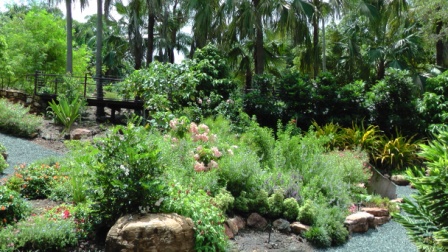
Another highlight of Darwin ... one of the most beautiful botanical gardens I have visited anywhere.   Including a rain forest, orchid garden, and tropical oasis, it really was stunning.   The variety of flowers and plants truly made it a natural experience to remember.
Our stay in Darwin was too short and a bit rushed.   But perhaps a brief visit is best.  Here's why:   It is mid summer here, it is the tropics.  Humidity is at 100%, and we passed by a bank where the temperature read 37 degrees (99F).   It was bearable to a point.  Then it became uncomfortable to be roaming around in it.  So, why not go to the beach?  That's another problem.  The beaches looked nice, but they are off limits.  The ocean here is filled with poisonous jelly fish and ... there are apparently a lot of hungry crocodiles that have been known to wander down the shoreline and attack unsuspecting sunbathers.   Being a Sunday, there were lots of people at parks having barbecues, playing soccer, and obviously better acclimated to the heat and humidity than me.  But the beaches were empty.

Now, two days at sea.   Time for reading (two books completed, now starting a third), relaxation, reflection.  Life is precious, enjoy every day.

Update:  On Monday, our first day of sea after Darwin, the captain came on the PA system and announced the ship was changing course and streaming full speed toward Milingimbi, a small town on Australia’s north coast.   A crew member had suffered a heart attack and needed to be airlifted off the ship.   Within three hours, a spotter plane flew overhead as a rescue medical helicopter set down on the ship’s front deck.  This morning, we were told the crew member was flown to Darwin where he is in serous, but stable condition.  For those of you who have known me for many years, you may remember the same thing happened to me when I suffered a ruptured appendix while in the middle of the Pacific Ocean.   The Holland America ship we were on had to change course toward northern California, and when we were within range, the military sent a rescue crew out from Moffat Field to pluck me off the ship and take me to Stanford.   
Then Monday evening, a waterspout formed a few miles off the port side (left side) of the ship.  It was fascinating to watch, with nothing but blue ocean waters in its path.

Saturday, February 23, 2013

Bali ... or bust?


The good people of Bali (and we met a lot of them) would likely be disappointed if they read what I'm about to write. In fairness, my views of their Island are likely influenced by unfortunate circumstances largely beyond their control.

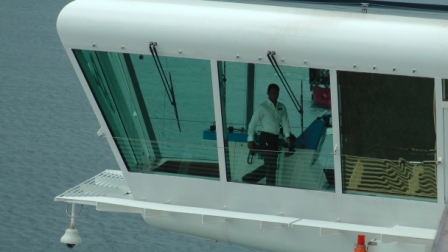
First, it rained ... in fact poured rain ... for most of the two days we were there.  And our arrival was marred by a stand-off between Indonesian immigration and the Solstice top brass that resulted in a lengthy delay of getting off the ship.  We could see the officers on cell phone with binoculars pacing back and forth on the bridge, trying to figure out what to do. We were suppose to disembark at 8:00AM.  We didn't get off until 12:30PM.
 
But even if you take those factors out of the equation, the fact is Bali fell short when it came to living up to this image I had of it being a beautiful tropical Paradise.  The majority of my fellow travelers, upon returning to the ship, were in agreement, some outraged the ship would even stop there (but these are the people who seem to complain about everything, going through life with a bad attitude).  Others, who booked themselves into a resort were a bit kinder.

I was reminded at least a couple of times that Bali is a third world country where poverty is prevalent throughout the small communities. But Mexico, where I live, is also considered a third world country by many (I would argue that Mexico is rapidly rising above third world status) and the differences between Mexico and Bali are significant.  

Upon exiting the port in Benoa, we were confronted by hundreds of locals, pushing, pulling, thrusting junky trinkets into our face, into our hands.  Likewise, there were swarms of drivers, each trying to out yell the other in an effort to get you to ride in their car.   We were warned that thieves and pickpockets were thick among the hucksters and to not wear jewelry or carry wallets or large amounts of cash.  We had no problems, but it certainly wasn't a flower lei greeting.

Within 20 miles beyond the port, we found predominantly crowded unkept communities, where survival, not luxury, marks the existence of the residents.   Unlike Puerto Vallarta, unlike Hawaii, unlike other established tourist destinations, my take was in general, Bali is not there.  That being said, we (and others we talked with) had some new experiences that were memorable.

Eighty percent of the population here is Hindu and every Hindu home has a temple in it, from a little shrine in the corner of the room to block long edifices built by extended families.  It is a deeply sincere populace (hucksters aside) where the people we met have a genuine connection with their spiritual  being and an interest in respecting others.  I must say it was enlightening and refreshing.  We visited the Batuan temple, but the torrential rains impacted our brief stay.  Even so, I felt blessed to be there.  It was one of two highlights of my visit.   The other at the other end of the spectrum ... The Elephant Safari Park.

It was touristy, but the first night in Bali, we took the 90 minute drive outside the cities.  A narrow road winding through the tropical jungle took us past rice fields tiered on the sloping hillsides to a sanctuary where 30 elephants have been rescued from Sumatra.   It is a beautiful spot where the sacred elephants are treated like royalty, and have become acclimated living with humans.   Feed an elephant?  Sure.  Ride an elephant? OK.   I connected with our elephant, Barry, who I am certain is thinking of our experience together now.

Also of interest in Bali, a neighborhood where monkeys outnumber residents.  They are everywhere, hanging from power lines, swooping down plucking food from the hands on unsuspecting tourists. We were told to protect our sunglasses and cameras, the monkeys might make off with them.  It was very amusing.
 
The island is loaded with spas and massage parlors, and bargaining is a way of life there except at the major hotel resorts that we did not see.   We were told a half day of a full treatment at a spa costs about $100.  

The most significant lasting impression I take from Bali is that of the people ... They are extremely gracious, polite, and they want to make sure you love their country and their customs.   From guides, to waiters, to drivers, to police.  That's why I feel a bit disheartened that I did not leave Bali with the most positive impression.
 
Interesting facts about Bali.  Gasoline is very cheap, about $1.60 a gallon,  5 pesos a liter.   There are a few gas stations, but mostly gasoline is sold in one liter water or liquor bottles from little stands by the side of the road.  There are no pay phones anymore (and very few land lines),  but cell service is so cheap, you can ask anyone to use their cell phone.  It was a port police officer who told us there were no phones, but offered us his cell to use to make a local call, then walked away, returning a few minutes later when we were finished.   He just wanted to help.  There is no cable TV or satellite available, you only get a few channels the old fashion way (by antenna) and they have not seen flat screen or HDTVs yet.   McDonalds, KFC, and Pizza Hut are everywhere, bringing their "quality" of food to this part of the world.

Monday, February 18, 2013

Summer in Port Hedland


If you look at a map of Australia, on the upper left hand side of the continent (the northwest corner), you may see a very very tiny dot with little letters that say "Port Hedland."  It is here where Celebrity felt the need to dock and spend nine hours.  It provided good material for the comedian on board last night who simply asked, “Why?”

With a population of 15,000, Port Hedland is known as "cyclone center" in Australia, since more cyclones hit here (an average of one every two years) than anywhere else in Australia.  It is also the community where in the 1960s, major iron ore deposits were discovered.  Combine cyclones and iron-ore mines and you get a pretty good idea of the appeal of Port Hedland.

The ship docked in the middle of the bustling cargo port where big freighters take off, laden with iron ore and salt. Port Hedland handles more tonnage than any other port in Australia, and they are proud of it.  This is a true working class town where the tallest two structures are the water tower and the control tower for the port. 
 
The town offered a shuttle from the port to the center of town (about three minutes away  ... we would have walked but they don't allow passengers to wander through the port).   In the center of town, the major attraction is a Woolworth store ... where we bought a tube of toothpaste.  Now you're really getting a feel for the excitement of Port Hedland.   
OK, so sometimes I’m a little tough.  The reality is, we have visited places with much less appeal than Port Hedland.
One cool thing here, there is still a fairly good aboriginal population, and we encountered an old aboriginal woman artist.   She was as fascinated to hear that she was talking to someone from "as far away as Mexico" as we were talking to her about life, such as it is, in Port Hedland.  It is a simple existence.  She said they just got television here 20 years ago (she asked if we had good television yet in Mexico!), and Internet is a fairly new phenomenon as well.  Only one little shack in town has Internet, and the local residents were in awe of all the cruise ship passengers who swamped their little building which provides the sole link to the cyber world ($1 for 30 minutes online, and it held up well under the crush of users … actually very impressive).
 
Sailing out of Port Hedland, dozens of empty ships were lined up to take on loads of iron ore (our departure was delayed by a half hour because of the shipping traffic jam).   And the highlight of Port Hedland …. the sunset over the Indian Ocean.    It is already my new screen saver, and likely will be for a long time, reminding me of the interesting day spent in Port Hedland.

Travel note:  We have now left the arid south of Australia and are entering the tropical north.  The temperature here today is over 100F, 38C, with high humidity.  On the horizon, we can see large thunderstorms building over the vast inland plains.   It is much like Puerto Vallarta in the summer ... climate and sunset-wise and that's about it.   Also, while Starbucks has not yet invaded Australia (there are just a very few in Sydney, Brisbane, and Melbourne), McDonalds is everywhere, actually more than you see in the US and Mexico (we were told there is a McDonald "near here," but not one in Port Hedland .... "near here" could be 50 miles away).  We haven't been to any of them (we don't go there when we are home either), but some people on the ship say they are "just as good as they are in Tulsa." 

Sunday, February 17, 2013

The jewels of Western Australia


When Celebrity said that we would be going to Perth, only to find out that we would actually be docking in a place called Fremantle, 30 minutes to the south, we thought great, another crummy little port town where we will look out over ship yards and shipping containers.  In reality, Fremantle turned out to be among the nicest small ports where we have ever docked.

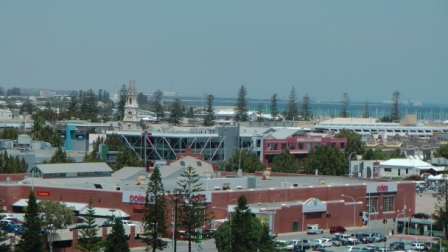
Fremantle, as it turns out, is a real city onto its own, not merely a gateway to its larger neighbor to the north.  The Solstice docked close to the center of town, and adjacent to a rail station where trains ran every twenty minutes to Perth.  As we walked into downtown Fremantle, we found a town that has retained a certain charm dating back to the mid nineteenth century when it was founded.  City hall was in the dead center of town, and from there, like spokes on a bicycle wheel, the streets stretched out for several blocks.  The covered sidewalks made the town look a lot like the old gold mining towns of California, but instead of trying to create this feeling of going back into an old historic town, Fremantle is actually a thriving working city.  The colorful buildings in town house restaurants, grocery stores, pubs, offices, theaters, and the various types of shops that nowadays you find mostly in suburbs and strip malls.   The cafes and restaurants that spilled onto the sidewalks were crowded and alive, providing an energetic vibe in a town otherwise might have seemed quaint and cerebral.

The old Fremantle market which stretches over two city blocks is a maze of specialty food shops. It is an open air market (open daily) where you can buy everything from fresh fruits and vegetables, a huge selection of cheeses, meats and salamis, specialty breads and pastries to several varieties of paella simmering in large cooking vats.   And here, street musicians looking for donations don't strum guitars ... they play didgeridoos and violins.

Fremantle provides free public transportation throughout the city, and free high speed WiFi throughout the central core of town.  It's like a contemporary city caught in a time warp.   With a Mediterranean climate (it was about 95 degrees and sunny while we sere there) we actually said that it is a place where we could live.  Except, again, like every town here, it is very expensive, with food costing two to three times as much as it is in the US and Mexico ($4.50 for a small Coke at a sidewalk cafe).

After the morning in Fremantle, we hopped the train for the ride into Perth.   During the thirty minutes on board, we passed through really cool ocean communities, with long white sandy beaches, surfers and wind surfers.   The stations where we stopped all looked amazingly clean and modern, and soon the train was packed with passengers, mostly students who attend private high schools outside of Perth and who were heading home after a day of classes.

Like in Europe, the train station in Perth was in the center of the huge metropolitan city, a city that reminded me of a cross between Portland, Oregon; Sacramento, California; and Vancouver, British Columbia.

Perth is the financial and commercial hub for Western Australia, a city filled with high rises, and giant shopping centers.   Unlike many American cities where suburban malls have zapped the strength and viability of urban centers, Perth is very much alive.   We took a public bus (again, free transportation in the city core) to King's Park, which is a beautifully manicured park overlooking the city and the river on which it was built.  With Perth serving a a strategic outpost during World War II, there are many monuments here honoring those who lost their lives.  There is also a large memorial from the US recognizing the "unbreakable bond" between the two countries.

With temperatures just shy of 100, by late afternoon we had had enough touring and caught the train back to Fremantle, where a swim in the pool was very welcome.

Australian oddity:   In large and medium size cities throughout the country, there is a chain store that looks very familiar to Americans.  It is Target, but there is something different about it than the Targets we are used to in the US.  First, the logo is a bit askew, and when you go into an Australian Target, it looks more like a Kmart than the more upscale Targets we are used to.  An Aussie told us that several years ago, "Target" opened here, and almost immediately the Minneapolis based Target sued them.   There was some sort of a settlement, but in the end, the US Target allowed the Australian Target to retain the name, even though the stores here are an inferior replica of the US stores.