Monday, February 25, 2013

Darwin ... and rescue at sea


One of the truly pleasant (and I would say unexpected) aspects of this voyage is the introduction to some very enjoyable cities and towns in both New Zealand and Australia.   Part of the pleasure comes not just with seeing a new place, but gaining a better understanding of its significance on this earth, its views of the outside world, and the history it has experienced that helps comprise the soul of the community.
 
I really knew very little about Darwin, Australia, but I sail away from this community of 90,000 inhabitants with respect and admiration.  On the surface, it is a clean, contemporary town with a small yet vibrant downtown.  It is the largest city on the north coast of Australia, and it is deeply in the tropics.  Those two facts have had more influence on modern day Darwin than perhaps anything else.   Because twice in the past 73 years, Darwin has been destroyed.    Not just damaged, but pretty much wiped off the face of the map.
 
Among the places I wanted to visit in Darwin were the underground oil storage bunkers from WWII.  In the cliffs adjacent to the port and wharf, a maze of underground tunnels were dug in 1942-43.   The walls were sealed in metal casings, and it is here where the Australian military planned to store fuel.    The need for the underground bunkers became apparent in the days following Japan's bombing of Pearl Harbor.  That's because after their successful bombing mission in Honolulu, the Japanese pilots turned around, refueled, reloaded, and took aim on Darwin, a strategic military port for Australia, the US, and the allies.  A relentless attack in December, 1942, destroyed the above ground oil storage facilities in Darwin, the airport, and most of the town.   Darwin became known as Australia's Pearl Harbor.  Loss of life was significant, and throughout the war, Darwin was bombed frequently.   Thus the need for underground fuel bunkers …  and thus, the need to rebuild most of the city after the war ended.

The next place I wanted to visit was the Northern Territories Museum, which in addition to housing impressive exhibits of cool Aboriginal art (no photos allowed there), they also had an eerie exhibit of the events of Christmas Day, 1974.   That's when Cyclone Tracy took dead aim on Darwin.  Absolutely nothing was left of the town.  Winds measured at 220 miles per hour leveled everything ... homes, downtown, city hall, the Parliament building.   TV News video and still shots from newspapers reminded me of the devastation following the tsunami in Japan.   But actually, it looked worse in Darwin. Because of the total destruction again less than 40 years ago, Darwin has rebuilt into one of the most modern cities I have ever visited.  
 
Not that that's a good thing, but just reality, that mankind (through war) and Mother Nature (through the elements) have forced more hardship on this particular community in 30 years than most others ever experience.
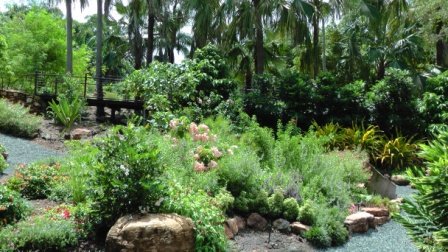
Another highlight of Darwin ... one of the most beautiful botanical gardens I have visited anywhere.   Including a rain forest, orchid garden, and tropical oasis, it really was stunning.   The variety of flowers and plants truly made it a natural experience to remember.
Our stay in Darwin was too short and a bit rushed.   But perhaps a brief visit is best.  Here's why:   It is mid summer here, it is the tropics.  Humidity is at 100%, and we passed by a bank where the temperature read 37 degrees (99F).   It was bearable to a point.  Then it became uncomfortable to be roaming around in it.  So, why not go to the beach?  That's another problem.  The beaches looked nice, but they are off limits.  The ocean here is filled with poisonous jelly fish and ... there are apparently a lot of hungry crocodiles that have been known to wander down the shoreline and attack unsuspecting sunbathers.   Being a Sunday, there were lots of people at parks having barbecues, playing soccer, and obviously better acclimated to the heat and humidity than me.  But the beaches were empty.

Now, two days at sea.   Time for reading (two books completed, now starting a third), relaxation, reflection.  Life is precious, enjoy every day.

Update:  On Monday, our first day of sea after Darwin, the captain came on the PA system and announced the ship was changing course and streaming full speed toward Milingimbi, a small town on Australia’s north coast.   A crew member had suffered a heart attack and needed to be airlifted off the ship.   Within three hours, a spotter plane flew overhead as a rescue medical helicopter set down on the ship’s front deck.  This morning, we were told the crew member was flown to Darwin where he is in serous, but stable condition.  For those of you who have known me for many years, you may remember the same thing happened to me when I suffered a ruptured appendix while in the middle of the Pacific Ocean.   The Holland America ship we were on had to change course toward northern California, and when we were within range, the military sent a rescue crew out from Moffat Field to pluck me off the ship and take me to Stanford.   
Then Monday evening, a waterspout formed a few miles off the port side (left side) of the ship.  It was fascinating to watch, with nothing but blue ocean waters in its path.

Saturday, February 23, 2013

Bali ... or bust?


The good people of Bali (and we met a lot of them) would likely be disappointed if they read what I'm about to write. In fairness, my views of their Island are likely influenced by unfortunate circumstances largely beyond their control.

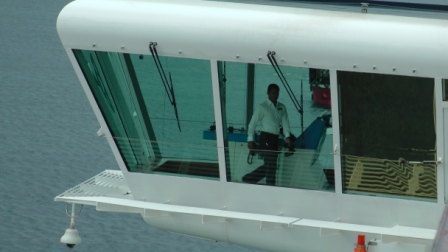
First, it rained ... in fact poured rain ... for most of the two days we were there.  And our arrival was marred by a stand-off between Indonesian immigration and the Solstice top brass that resulted in a lengthy delay of getting off the ship.  We could see the officers on cell phone with binoculars pacing back and forth on the bridge, trying to figure out what to do. We were suppose to disembark at 8:00AM.  We didn't get off until 12:30PM.
 
But even if you take those factors out of the equation, the fact is Bali fell short when it came to living up to this image I had of it being a beautiful tropical Paradise.  The majority of my fellow travelers, upon returning to the ship, were in agreement, some outraged the ship would even stop there (but these are the people who seem to complain about everything, going through life with a bad attitude).  Others, who booked themselves into a resort were a bit kinder.

I was reminded at least a couple of times that Bali is a third world country where poverty is prevalent throughout the small communities. But Mexico, where I live, is also considered a third world country by many (I would argue that Mexico is rapidly rising above third world status) and the differences between Mexico and Bali are significant.  

Upon exiting the port in Benoa, we were confronted by hundreds of locals, pushing, pulling, thrusting junky trinkets into our face, into our hands.  Likewise, there were swarms of drivers, each trying to out yell the other in an effort to get you to ride in their car.   We were warned that thieves and pickpockets were thick among the hucksters and to not wear jewelry or carry wallets or large amounts of cash.  We had no problems, but it certainly wasn't a flower lei greeting.

Within 20 miles beyond the port, we found predominantly crowded unkept communities, where survival, not luxury, marks the existence of the residents.   Unlike Puerto Vallarta, unlike Hawaii, unlike other established tourist destinations, my take was in general, Bali is not there.  That being said, we (and others we talked with) had some new experiences that were memorable.

Eighty percent of the population here is Hindu and every Hindu home has a temple in it, from a little shrine in the corner of the room to block long edifices built by extended families.  It is a deeply sincere populace (hucksters aside) where the people we met have a genuine connection with their spiritual  being and an interest in respecting others.  I must say it was enlightening and refreshing.  We visited the Batuan temple, but the torrential rains impacted our brief stay.  Even so, I felt blessed to be there.  It was one of two highlights of my visit.   The other at the other end of the spectrum ... The Elephant Safari Park.

It was touristy, but the first night in Bali, we took the 90 minute drive outside the cities.  A narrow road winding through the tropical jungle took us past rice fields tiered on the sloping hillsides to a sanctuary where 30 elephants have been rescued from Sumatra.   It is a beautiful spot where the sacred elephants are treated like royalty, and have become acclimated living with humans.   Feed an elephant?  Sure.  Ride an elephant? OK.   I connected with our elephant, Barry, who I am certain is thinking of our experience together now.

Also of interest in Bali, a neighborhood where monkeys outnumber residents.  They are everywhere, hanging from power lines, swooping down plucking food from the hands on unsuspecting tourists. We were told to protect our sunglasses and cameras, the monkeys might make off with them.  It was very amusing.
 
The island is loaded with spas and massage parlors, and bargaining is a way of life there except at the major hotel resorts that we did not see.   We were told a half day of a full treatment at a spa costs about $100.  

The most significant lasting impression I take from Bali is that of the people ... They are extremely gracious, polite, and they want to make sure you love their country and their customs.   From guides, to waiters, to drivers, to police.  That's why I feel a bit disheartened that I did not leave Bali with the most positive impression.
 
Interesting facts about Bali.  Gasoline is very cheap, about $1.60 a gallon,  5 pesos a liter.   There are a few gas stations, but mostly gasoline is sold in one liter water or liquor bottles from little stands by the side of the road.  There are no pay phones anymore (and very few land lines),  but cell service is so cheap, you can ask anyone to use their cell phone.  It was a port police officer who told us there were no phones, but offered us his cell to use to make a local call, then walked away, returning a few minutes later when we were finished.   He just wanted to help.  There is no cable TV or satellite available, you only get a few channels the old fashion way (by antenna) and they have not seen flat screen or HDTVs yet.   McDonalds, KFC, and Pizza Hut are everywhere, bringing their "quality" of food to this part of the world.

Monday, February 18, 2013

Summer in Port Hedland


If you look at a map of Australia, on the upper left hand side of the continent (the northwest corner), you may see a very very tiny dot with little letters that say "Port Hedland."  It is here where Celebrity felt the need to dock and spend nine hours.  It provided good material for the comedian on board last night who simply asked, “Why?”

With a population of 15,000, Port Hedland is known as "cyclone center" in Australia, since more cyclones hit here (an average of one every two years) than anywhere else in Australia.  It is also the community where in the 1960s, major iron ore deposits were discovered.  Combine cyclones and iron-ore mines and you get a pretty good idea of the appeal of Port Hedland.

The ship docked in the middle of the bustling cargo port where big freighters take off, laden with iron ore and salt. Port Hedland handles more tonnage than any other port in Australia, and they are proud of it.  This is a true working class town where the tallest two structures are the water tower and the control tower for the port. 
 
The town offered a shuttle from the port to the center of town (about three minutes away  ... we would have walked but they don't allow passengers to wander through the port).   In the center of town, the major attraction is a Woolworth store ... where we bought a tube of toothpaste.  Now you're really getting a feel for the excitement of Port Hedland.   
OK, so sometimes I’m a little tough.  The reality is, we have visited places with much less appeal than Port Hedland.
One cool thing here, there is still a fairly good aboriginal population, and we encountered an old aboriginal woman artist.   She was as fascinated to hear that she was talking to someone from "as far away as Mexico" as we were talking to her about life, such as it is, in Port Hedland.  It is a simple existence.  She said they just got television here 20 years ago (she asked if we had good television yet in Mexico!), and Internet is a fairly new phenomenon as well.  Only one little shack in town has Internet, and the local residents were in awe of all the cruise ship passengers who swamped their little building which provides the sole link to the cyber world ($1 for 30 minutes online, and it held up well under the crush of users … actually very impressive).
 
Sailing out of Port Hedland, dozens of empty ships were lined up to take on loads of iron ore (our departure was delayed by a half hour because of the shipping traffic jam).   And the highlight of Port Hedland …. the sunset over the Indian Ocean.    It is already my new screen saver, and likely will be for a long time, reminding me of the interesting day spent in Port Hedland.

Travel note:  We have now left the arid south of Australia and are entering the tropical north.  The temperature here today is over 100F, 38C, with high humidity.  On the horizon, we can see large thunderstorms building over the vast inland plains.   It is much like Puerto Vallarta in the summer ... climate and sunset-wise and that's about it.   Also, while Starbucks has not yet invaded Australia (there are just a very few in Sydney, Brisbane, and Melbourne), McDonalds is everywhere, actually more than you see in the US and Mexico (we were told there is a McDonald "near here," but not one in Port Hedland .... "near here" could be 50 miles away).  We haven't been to any of them (we don't go there when we are home either), but some people on the ship say they are "just as good as they are in Tulsa." 

Sunday, February 17, 2013

The jewels of Western Australia


When Celebrity said that we would be going to Perth, only to find out that we would actually be docking in a place called Fremantle, 30 minutes to the south, we thought great, another crummy little port town where we will look out over ship yards and shipping containers.  In reality, Fremantle turned out to be among the nicest small ports where we have ever docked.

Fremantle, as it turns out, is a real city onto its own, not merely a gateway to its larger neighbor to the north.  The Solstice docked close to the center of town, and adjacent to a rail station where trains ran every twenty minutes to Perth.  As we walked into downtown Fremantle, we found a town that has retained a certain charm dating back to the mid nineteenth century when it was founded.  City hall was in the dead center of town, and from there, like spokes on a bicycle wheel, the streets stretched out for several blocks.  The covered sidewalks made the town look a lot like the old gold mining towns of California, but instead of trying to create this feeling of going back into an old historic town, Fremantle is actually a thriving working city.  The colorful buildings in town house restaurants, grocery stores, pubs, offices, theaters, and the various types of shops that nowadays you find mostly in suburbs and strip malls.   The cafes and restaurants that spilled onto the sidewalks were crowded and alive, providing an energetic vibe in a town otherwise might have seemed quaint and cerebral.

The old Fremantle market which stretches over two city blocks is a maze of specialty food shops. It is an open air market (open daily) where you can buy everything from fresh fruits and vegetables, a huge selection of cheeses, meats and salamis, specialty breads and pastries to several varieties of paella simmering in large cooking vats.   And here, street musicians looking for donations don't strum guitars ... they play didgeridoos and violins.

Fremantle provides free public transportation throughout the city, and free high speed WiFi throughout the central core of town.  It's like a contemporary city caught in a time warp.   With a Mediterranean climate (it was about 95 degrees and sunny while we sere there) we actually said that it is a place where we could live.  Except, again, like every town here, it is very expensive, with food costing two to three times as much as it is in the US and Mexico ($4.50 for a small Coke at a sidewalk cafe).

After the morning in Fremantle, we hopped the train for the ride into Perth.   During the thirty minutes on board, we passed through really cool ocean communities, with long white sandy beaches, surfers and wind surfers.   The stations where we stopped all looked amazingly clean and modern, and soon the train was packed with passengers, mostly students who attend private high schools outside of Perth and who were heading home after a day of classes.

Like in Europe, the train station in Perth was in the center of the huge metropolitan city, a city that reminded me of a cross between Portland, Oregon; Sacramento, California; and Vancouver, British Columbia.

Perth is the financial and commercial hub for Western Australia, a city filled with high rises, and giant shopping centers.   Unlike many American cities where suburban malls have zapped the strength and viability of urban centers, Perth is very much alive.   We took a public bus (again, free transportation in the city core) to King's Park, which is a beautifully manicured park overlooking the city and the river on which it was built.  With Perth serving a a strategic outpost during World War II, there are many monuments here honoring those who lost their lives.  There is also a large memorial from the US recognizing the "unbreakable bond" between the two countries.

With temperatures just shy of 100, by late afternoon we had had enough touring and caught the train back to Fremantle, where a swim in the pool was very welcome.

Australian oddity:   In large and medium size cities throughout the country, there is a chain store that looks very familiar to Americans.  It is Target, but there is something different about it than the Targets we are used to in the US.  First, the logo is a bit askew, and when you go into an Australian Target, it looks more like a Kmart than the more upscale Targets we are used to.  An Aussie told us that several years ago, "Target" opened here, and almost immediately the Minneapolis based Target sued them.   There was some sort of a settlement, but in the end, the US Target allowed the Australian Target to retain the name, even though the stores here are an inferior replica of the US stores.

Thursday, February 14, 2013

When the ship hits the fan

I have sometimes wondered why cruise companies choose certain ports.  Some are obvious as being major tourist spots with lots to offer like Puerto Vallarta, Sydney, San Francisco, and so on.

But sometimes, the stops make no sense.  Such was the case in Esperance, Australia.  Esperance is perhaps most famous as being the place where in 1979, NASA's Skylab fell to earth (and, Esperance sent a $400 bill to the United States for littering.  The US refused to pay, but years later, a
Southern California disc jockey had his listeners contribute to pay the long overdue fine).  Well, in the 34 years since 1979, not a lot has happened in Esperance.  So when a cruise ship with 2850 passengers on board came to town, it was a BIG deal. This is the first time the Solstice had come to port, and it is the largest ship ever to come to Esperance. The good people of Esperance were ready.  Or so they thought.

Esperance is too small to have a ship dock.  In fact the only dock they do have is really so small and in such shallow waters that it really couldn't even fully support the tenders that had to ferry passengers from the ship to the shore. So, instead of being able to have four or five tenders carrying 150 people each to the dock, only one tender carrying 100 people could go at a time.

After about a half hour delay (not that bad, but then we were early), we made it to shore, and since there wasn't a lot to do there, and since I needed to do some work online, I needed to find WiFi.  That was problem number two.  Only four places in town had Internet ... McDonalds, the Esperance Library, a place called Z-zone, and a cafe called Dome.  We first went to the library which wasn't scheduled to open for another fifteen minutes.  But a matronly woman came to the front door and asked what we were waiting for.  We told her we wanted to use the Internet.  She apologized and said it hadn't been working for a couple of days and suggested we try Z-zone.  A few blocks away, we found Z-zone, but they only had a few old terminals in a back room where you could check email and no WiFi. "Go to the library," the smiling tattooed man at the desk suggested.  Knowing the story at the library, it was next off to McDonalds.  But as we were walking there, we encountered some other friends from the ship who said McDonalds wasn't working either.  That left Dome.

We were among the first to arrive there, ordered two smoothies (for twice the price you'd pay in the US, but hey, we were getting "free Internet").  And it was free, and it was fast, and it was great ... Until the other 2850 people from the ship eventually got to shore and discovered that Dome was the only place that had working WiFi.  Actually, it was only a few hundred people who went to Dome, but in a town where probably only two dozen people are online at the same time, you can imagine the results.  The system finally just locked up, and no one could get online, and those who were online couldn't do anything.  We joked that in addition to Skylab, Esperance would now be known as the place that broke the World Wide Web.

Enough fun for one day, we made a call to a private company in Bali where next week we've arranged to do a nighttime elephant safari.  Trying to use a pay phone in a foreign country calling another foreign country is a story in itself, but I won't even get into that. We then headed back to the tiny dock where we would catch the tender back to the ship anchored offshore ... Among with 2850 others.  The line stretched from the little pier for about four city blocks.  The ship's crew was handing out water and cold towels to keep the passengers from passing out in the 85 degree weather.  No problem for us, but I felt really bad for a lot of the elderly people who were clearly distressed.    After 90 minutes in line, we finally got on the tender.

But by then, the wind had come up, and the swells between the dock and the ship were about ten feet.  The little tender, which was sealed up water tight, rolled and pitched and slammed into waves.  At times, waves washed over the entire boat.  Women screamed, children cried (OK, there weren't any crying children, but a few women did let out a few gasps as the tender driver did all he could to maintain control).  A 20 minute ride took 35 minutes, but we made it, with all aboard giving a very loud round of applause to the pilot.

The next morning, Valentine's Day, we docked at Albany, only slightly larger than Esperance, but with its own dock, and a cool colonial type town right on the Indian Ocean.  Here, lots of places had Internet, but again, so many people tried to get online at the same time, the city's entire WiFi grid just locked up.

We were only in Albany from 7:00AM to noon,  and 2848 passengers made it back on board as we set sail.  That left two unaccounted for.  Over the entire ship, several times before leaving the dock, the announcement was repeated "Mr. and Mrs. Hobson from stateroom 7114, if you are somehow on board, please contact guest relations immediately." Well, at 11:59AM, they made the final announcement, just as I was getting into an elevator to go to the gym.  The elevator was packed, and one wise guy asked, "Where are you all going, up to the top deck, to see the Hobsons run onto the dock as the ship is pulling away?"  We never saw the Hobsons.  The same thing happened last week, and the guests had to get a flight to catch up with the ship at the next port.

Perth is next, where cruise #1 ends and cruise #2 begins.   Eighteen days down, seventeen more to go.

Tuesday, February 12, 2013

The roughest day in five months

Leaving the smoky skies of Hobart, we sailed west past the rugged coastline on Tasmania, our last stretch of the Tasman Sea.  Within a couple of hours , we entered the Indian Ocean where sea conditions deteriorated rapidly.


Winds picked up to 40-50 miles per hour, and swells increased to about 20 feet.  The result was an extremely rough night and following day.  In sddition to rolling side to side, the ship would shutter as it slammed into the towering waves ... just like an earthquake.   Our wine steward said it was the roughest 24 hour period the ship had experienced in five months.    Outside decks were closed, and it was difficult walking inside.  We stayed in the stateroom most of the day watching movies.  We didn't get sick, but the dining room  was pretty empty, indicating lots of people probably were.  


The conditions forced the ship to lower its speed, so we arrived in Adelaide at 10:30 AM, three and a half hours late, and an hour after a group of 12 of us had made a private reservation for a tour of the Barossa Valley wine region.  When we finally got off the ship and onto the mini van, we had missed the lunch we were suppose to have at one of the six wineries we were visiting.  And we missed three of the wineries.  All part of the adventure.


We did not have time to stop and explore Adelaide, but driving through, it appeared to be like several of the other Australia cities we've visited.   Very clean, modern, and livable.  It is also expensive.  The driver took us through a nice residential neighborhood where modest homes were going for $3 million.  Comparable homes in similar cities in California would probably be around $1 million.
Leaving the urban area, we soon entered rolling brown foothills, and about 45 minutes from downtown Adeleaide, the Australian wine country.  If you didn't know better, you'd swear you were in California's Napa Valley.  Amid the mile after mile of lush vineyards, there are 3000 wineries, from large international vintners (like Jacob's Creek) to tiny mom and pop operations.  I've never been a big fan of Australian wines, but those that we tried here were truly phenomenal.  We were told by the vintners that the best Australian wines stay in Australia, and only the cheaper varietals are exported for sale in the US.   If, by chance, however, you do come across a bottle of Wolf Blass Shiraz from the Barossa Valley, check it out.  It is amazing.
Arriving late, we also departed late from Adelaide, 9:00PM, and began the two day trek westward to Esperence, which reportedly has some of the most beautiful white sand beaches and coastline in the world.


Adelaide factoid:  While we have gone through five time zone changes since arriving in Auckland, we are only four hours behind Auckland.   That's because Adelaide is one of those few places on the earth where the time zone is 30 minutes, not one hour, from the adjacent time zones.   So, while it is 4PM in Sydney,  9PM in San Francisco, 11PM in Puerto Vallarta, it is 2:30PM in Adelaide.


Shipboard factoid:  For much if the past couple of decades, the majority of workers (waiters, room attendants, bar staff) have been from the Philippines.  That is changing, at least on this ship.  Most of the staff here is from India.   


Oh you Tasmanian Devil

The standard operating procedure for this cruise is that we leave port anywhere between 5:00 and 7:00 in the afternoon, and we arrive at the next port around 6:00 or 7:00 in the morning.  Docking is a quiet, smooth process, so we don't even know we are in port until we get up, open the curtains, and look outside to see where we are.

In some places, it is truly an awesome site.  For example in Sydney, we peered out onto the magnificent Sydney Opera House.  In other places, not so much.  That was the case as we pulled the curtains open in Hobart, Tasmania ... and looked out at docks loaded with shipping containers.  That is the more typical scene that greets us.  But look beyond the scuzzy foreground and often a gem of a town awaits.  Now, I'm not saying Hobart is a diamond, but it's not a hunk of coal either.

I first learned of Tasmania as a very young child (as probably most American baby boomers did) when the Tasmania devil was an appealingly repulsive cartoon character that I watched almost every Saturday morning on TV.  As I grew older, I lost interested in the cartoon devil, and thusly Tasmania.  But experiences encountered at a young age (even Saturday morning cartoons) are often indelibly etched in a child's fertile mind for life.  So when I discovered this cruise was actually going to a place called Tasmania, the site-seeing option for me was a no brainer.   I wanted to see the real Tasmanian devil.

I hiked over to a tourist info center, where I was told a bus was about to leave for Zoo Doo, a place out in the country where you can hang with the animals and see real Tasmanian devils.  I was sold.  

The half hour drive to Zoo Doo took us through rolling hillsides, dotted with small vineyards and wineries.   We also passed through empty fields where the driver told us poppies are grown ... poppies used for opium.   This is the place where much of the world's pharmaceutical opium comes from.   They say 99% percent of it is actually used for legitimate purposes.   One percent makes it to the black market.  And there is no security (so they say).  Here's why.  The government distributes the poppy seeds, and 98% percent of the seeds produce top grade opium.   The other two percent produce opium that causes instant death.   The government does not announce which fields are the deadly ones, so, you take your life in your hands if you want to rip off the opium fields.   They say that two years ago, two dopers died after choosing the wrong field.   How much of this is true, how much of it is government propaganda, how much of it is an embellishment from an over zealous bus driver, I don't know.  

But what I do know is that finally, I got to see my devil.  They don't look much like the characters from my Saturday mornings long ago.  You know, the one with the big head, gnarly mouth, who moved around like a tornado.   The ones we saw were the size of small dogs, like a terrier. Apparently, the Tasmania devils used to be all over Australia, but they have pretty much been wiped out.  They are still found on the island of Tasmania.     They ran around a bit, stared at us, one snarled at the other, but they were pretty docile looking (however, we were told not to put our fingers into the cage because the devils are fast moving and they love to bite off fingers).

Fortunately, the kangaroos are much more friendly.  We were able to just hang with them, and with a handful of kangaroo food, they would come right up to you, put their paws on your hands, and eat right out of your palms.   The camels and the emus also ate out of your hands, but you had to be careful they also didn't chomp down on your pinky finger (keep your hand in a fist and put the food on top of it).

Back in Hobart, we discovered a cool little seaside town, population 210,000 (half the population of the entire island).  It has a New England appeal to it, with a clean waterfront and marina spotted with shops and restaurants.  A custom wood boat show was taking place on the docks, and craftspeople were selling their wares.  All, very expensive compared to U.S. and Mexican standards.  The people here are very friendly. And when they ask where we live and we tell them Mexico, they look perplexed.  Most have never left this island, many have never left Hobart.
One thing that struck me about Hobart and the surroundings.  The climate is very similar to California and the Mediterranean.   Cool nights, hot afternoons, and very dry.  The hillsides are all brown now, just like California in the summertime.  And perhaps you have heard the news about the disastrous wildfires now burning through parts of Australia.  That, unfortunately, is happening to a large extent around Hobart.  By the time the ship set sail, the wildfires had flared significantly, with towering billows of smoke rising behind the town, and a thick smokey haze enveloping the city.  Some passengers complained that they were having trouble breathing, but to me, it just brought back memories of those long hot summers where I would spend days and weeks on the fire lines covering the infernos for News10.   

Next, in two days, we will be in Adelaide, Australia's wine growing region.

Thursday, February 7, 2013

The Sounds to Sydney

One of the cool things about this cruise is that other than the two day trek across the Tasman Sea, we are fairly close to land the entire time, circumventing New Zealand and Australia.  As such, we are often able to see the lights from shore at night, and during the day, we see some beautiful coastline.  Such was the case when we spent an entire day cruising in and out of the sounds of south western New Zealand.

They call them the fjords of New Zealand, Dusky, Doubtful, and Milford Sounds.  Carved over millions of years by glacial activity, the sounds were discovered by Captain Cook (though he did not want to fully venture into them for fear that his ship would get stuck).  Today, with sophisticated mapping, GPS, and depth finders, the world's largest ocean liners make easy passage through the narrow gorges. The sheer mountainsides drop rapidly into the salt water, thus providing hundreds of feet of ocean depth at the bottom of the narrow canyons.  Smaller tour boats can get right to up shore to allow their passengers to be sprayed by the mists of the many cascading falls. 

With over 60 feet of rainfall per year (yes feet, not inches), the steep mountains are lush, and there are dozens of waterfalls gushing from high above.  Though they are slowly vanishing here, glaciers still can be seen on the towering peaks when the weather is clear.   We were lucky, because although it was somewhat overcast, there was no rain, and the geologist/historian on board kept remarking what an unusual day it was weather wise, one of the best he had seen here.

Of the three sounds, only one has a very small town on it (Milford) with a hotel, and landing strip. This is a popular spot for locals to visit, though the accommodations are spartan.  And while the sounds of New Zealand are truly magnificent, we didn't think they quite measured up to the Scandinavian fjords which were breathtaking.

The sounds were the last stops in New Zealand before heading west over the Tasman Sea to Australia.  Before we set sail, we had heard horror stories of sailing over the Tasman.  It, apparently, is one of the roughest bodies of water in the world.   Some Australians that we have met on this cruise and who have been on the Tasman before recalled one cruise where the swells were so huge, the bow of the ship constantly was submerged as it plowed through the towering waves.  All activities and meals had to be cancelled.  For us, again, we were lucky.  It was a little rough with a few good rollers, but overall, not that bad.  In fact, the first night out of Auckland was worse.

The ship docked at Sydney harbor at 6:00AM Tuesday.  We weren't scheduled to arrive until 9:30, but because the port is such a busy place with commuter ferries, the port authority wanted the ship to be docked prior to the morning rush hour commute.  When we opened the curtains in our stateroom, this is the view we had ... We were docked right in front of the Sydney Opera House. Passengers on the other side of the ship had a full view of the Sydney bridge.  Most cruise ports in most cities are either miles from the central part of town or at the same dock as cargo ships, providing for a less than spectacular view or convenient location. But like the harbor in Vancouver, BC, or San Francisco, Sydney's cruise ship terminal is right in downtown Sydney and adjacent to the ferry terminal.  You walk off the ship, and you are in the midst of one of the most contemporary and metropolitan cities in the world.

Not big on organized tours, we walked the city, took local buses, and got a great feel for the city.  We even stumbled upon a three story Apple store where we were able to buy a photo adapter for a mini iPad that we have not been able to find anywhere else.  

Since the weather was sunny and warm, we took a bus out to Bondi Beach, famous for surfing competition and people watching.  Being a perfect summer day here, the beach was packed, and I will admit, I've never seen such a parade of pretty people who were happy to show off their Australian attributes.  Bondi beach puts St. Tropez to shame!

Overnighting in Sydney, on Wednesday we met up with a friend we had met on a cruise three years ago to the Baltics.  He lives in nearly Manly, and is a docent at the Sydney Opera House.  He gave us a 90 private tour of the Opera House, behind the scenes, back stage, and all over.  It is really a work of art and an engineering feat.   While I always thought it was modeled after egg shells, the Danish architect came up with the concept after slicing up an orange, then stacking the pieces together.  While hailed as a contemporary design masterpiece, the architect never visited the Opera House to see his project completed.   When the Australian Democratic Party which commissioned the opera house lost office, the incoming Conservative party no longer had interest in it and cut the funding.  The Danish architect left in disgust.  When the liberal party came back into office, they refunded the project, hired a local Sydney contractor, and completed the opera house 23 years after it was initially started ... 20 years late and more than 100 million dollars over the original budget of seven million dollars (the estimated cost back in the 1950s when it was first proposed).

The Sydney stay was rounded out with a 30 minute ferry ride to the beachside community of Manly, a quintessential resort town wedged between the Pacific Ocean and the inlet where Sydney is located.  It hasn't changed much in the 30 years since I was last there, a clean laid back spot with great restaurants, shops, and spectacular views.  

The people of Sydney are extremely helpful and truly interested in helping people who visit their beautiful city.  Ask someone on the street for directions or information, and in some cases, they will stop what they are doing to make sure you find what you are looking for.  You see little homelessness, the streets are impeccably clean, the parks and historic sites are well maintained.  

As we sailed out of Sydney harbor at sunset, we looked back at the disappearing skyline and remarked how this is a place where we could live ... if we had the money.  It is tremendously expensive, both property and living expenses. Maybe we'll just need to save up and visit again.

Now, we're off to Hobart, Tasmania, where if I can find a good Internet spot, I'll get this blog sent out.